Capital Calls Don't Wait: Build a Liquidity Budget
By Nick Bryant, Co-Founder and CTO, SMB Investor Network
7 min read
At a glance
Build a private investment liquidity budget that separates what you must pay, accepted commitments and uncertain distributions, with a blank cash calendar.
A capital call arrives on the fund's schedule, not yours, and an expected distribution can arrive years after the bill it was meant to pay. A private investment liquidity budget puts cash you have now next to what you need to spend, what you're obligated to fund and what you only hope to receive. Its job is to show where your plans lean on money you can't touch yet.
Start the private investment liquidity budget with what you must pay
Start with the spending your portfolio has to support. Housing, care, tuition, taxes and a planned change of work all need cash on dates that won't move because a fund hasn't returned capital. A portfolio valuation tells you nothing about whether cash will be there when those dates come.
Write each need in plain words. Note what makes its timing fixed or flexible, which account would pay it and what you don't know yet. Keep a planned purchase apart from an unavoidable payment even if they fall in the same month; the consequences differ when cash is late.
Don't make the calendar look complete by guessing. Leave an unknown amount or date blank and write the question beside it. A guessed number disappears into a total that looks more reliable than it is.
Separate cash that already has a job from cash that doesn't. A balance can look free when it's earmarked for next spring's tax bill. Writing the job down stops the same dollars from backing both your spending and a new commitment.
Keep this cash view beside your private-market portfolio map. The map says what you own and why. The liquidity budget says when that money can actually be used. Never count an estimated investment value as spendable cash.
Put accepted commitments in the liquidity budget
When the fund accepts your subscription, you have a future funding obligation while the money still sits in your account. Record that obligation apart from capital you've already paid in. Otherwise your balance suggests more room for the next deal than your existing promises allow.
Use separate labels for accepted unfunded commitments, subscriptions awaiting acceptance, calls you've received and deals you're only considering. An unaccepted subscription or a deal under consideration belongs in a planning conversation. Neither should look like an obligation, and a real obligation shouldn't get lost in a list of maybes.
A capital call is the fund's request for money you've already committed. Separate the notices you've received from calls you expect, and settle any doubt from the documents rather than from memory.
Keep each commitment linked to its calls. When a call notice arrives, record the payment due. Reduce the unfunded commitment when the payment is made and reconciled against the fund's records. Until then, show the unpaid call as a pending cash use within the unfunded commitment, not as an outflow that has already occurred.
The opposite mistake is just as easy. A quiet year with no calls doesn't shrink what you still owe. Keep the unfunded balance in view whenever you look at available cash, and if the record is incomplete, mark it incomplete rather than read the gap as room to commit more.
Then ask: does your plan still hold if calls arrive while expected distributions are late? You don't need a probability or a reserve percentage to see which plans depend on that not happening.
Separate uncertain receipts from cash already received
A distribution forecast is a possible payment. It isn't money in your account. Keep forecasts visible, because they matter to planning, but give them a different status from cash that has arrived.
Use exact labels. "Received and available" means the money is in the account and nothing restricts its use. "Announced, not received" means you've been told a payment is coming. "Forecast" means someone expects one. An announcement is useful information, not spending money.
A newly acquired business may hold back cash to build a reserve rather than pay investors. That can be good management and still leave you with a timing problem: cash inside the business is not cash paid to you.
So a report describing a company's healthy cash position doesn't tell you what you'll receive or when. File the business update with the investment record, and keep any payout forecast marked as conditional.
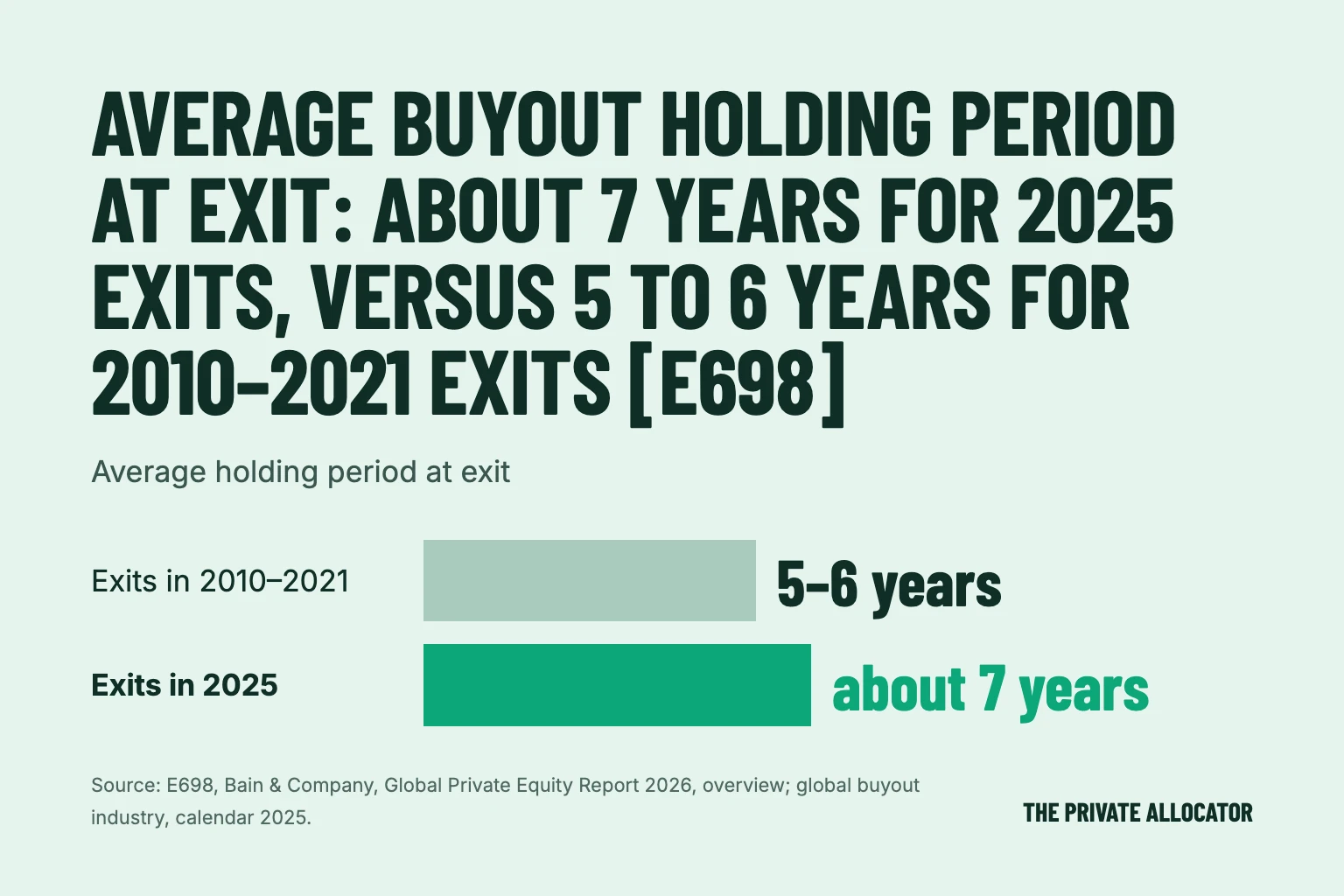
Industry data shows how slowly cash can come back. Bain reports that the average buyout holding period at exit was about seven years in 2025, up from five to six years for exits in 2010 to 20211. Distributions were 14 percent of net asset value in 2025, below 15 percent for the fourth year running, and 53 percent of surveyed LPs say undrawn commitments limit new commitments2. The holding-period and distribution figures describe the wider buyout market; the LP response is a survey share. None tells you when cash will arrive from a fund you hold, but they warn against treating "a few years" as a firm deadline. Our private equity J-curve, modeled for one household turns that warning into a year-by-year calendar of calls and distributions for a single commitment.
Buyout cash came back slowly in 2025
Three labeled measures on separate scales. Average holding period at exit: 5 to 6 years for exits in 2010 to 2021, drawn as a range, and about 7 years for exits in 2025. Distributions as a share of net asset value in 2025: 14%, below 15% for the fourth year running. Surveyed LPs who say undrawn commitments limit new commitments: 53%.Average holding period at exit
Exits in 2010–2021: 5–6 years
Exits in 2025: about 7 years
Distributions as a share of net asset value
2025, below 15% for the fourth year running: 14%
LPs who say undrawn commitments limit new commitments
Surveyed LPs, 2025: 53%
Filled: reported value. Outlined: Bain’s published range. Dashed: a figure Bain calls approximate. Each measure has its own scale.
Source: Bain & Company, Global Private Equity Report 2026, overview; global buyout industry, calendar 202512. The 2010–2021 holding period is Bain's published range and the 2025 figure is described as about seven years. Industry aggregates, not the terms or timing of any fund or household.
Figure data
| Measure | Group | Value |
|---|---|---|
| Average holding period at exit | Exits in 2010–2021 | 5–6 years |
| Average holding period at exit | Exits in 2025 | about 7 years |
| Distributions as a share of net asset value | 2025, below 15% for the fourth year running | 14% |
| LPs who say undrawn commitments limit new commitments | Surveyed LPs, 2025 | 53% |
Keep a change in value apart from a movement of cash. A higher valuation belongs in the portfolio record, not as an inflow on the cash calendar. And when a forecast payment actually arrives, retire the forecast so it isn't counted again.
For each forecast, note where it came from, what has to happen before it's paid and what would make you revisit it. "Payment depends on a sale that hasn't happened" is more useful than a date the source doesn't support.
Then read the calendar with every forecast removed. Which needs and obligations still have a source of cash? Where there's a gap, name it. Don't close it with a hoped-for sale or distribution.
Check withdrawal constraints before assuming access
How cash can reach you depends on the fund's structure. The question to answer before investing is: how do I actually get my money back? A closed-end fund returns capital as it sells assets and winds down over a fixed term. An open-end fund runs indefinitely and lets you ask for your money back, but a lockup may delay requests and a gate may cap withdrawals, so a full exit can still take a long time.
Our comparison of closed-end and open-end funds covers the vocabulary. A closed-end fund's stated term is not a promise that cash reaches you by then. An open-end label doesn't mean you can withdraw whenever you need to.
A lockup can bar a withdrawal request for a set period. A gate can cap how much gets paid out. Being allowed to submit a request, having it accepted and receiving the cash are three separate events. Don't give them one shared payment date in your notes.
Use the current documents for each holding. If they don't make clear how a restriction applies, leave the timing open and write down what you need to ask.
For each holding, an access note answers:
- How could cash come back to you?
- What conditions apply before you can ask for it?
- What could limit or delay payment after you ask?
- Which current document supports that answer?
- What's still uncertain?
The note isn't a ranking of funds, and a withdrawal feature doesn't make an investment right for a particular need. Its job is to catch the places where your spending plan assumes access you haven't confirmed.
Build a blank cash calendar for the liquidity budget
Keep the calendar simple enough to update the day a notice arrives. The structure below separates uses of cash from receipts and gives uncertainty a column. Dates and amounts are blank on purpose; fill them in privately from your own records.
| Cash item | Date or timing | Amount | Status and supporting record | Unresolved question |
|---|---|---|---|---|
| Personal or family spending need | ||||
| Accepted unfunded commitment | ||||
| Subscription awaiting acceptance | ||||
| Capital call received | ||||
| Optional new investment | ||||
| Receipt received and available | ||||
| Payment announced but not received | ||||
| Forecast receipt | ||||
| Withdrawal request awaiting payment |
Repeat a row for each item rather than lumping unrelated needs together. Use the status column to separate firm information from assumptions. Where the document gives no date, leave the date blank and put the timing question next to it.
Read across each row before reading down. Does the source support the status? Does this cash already have another job? Is a receipt really available, or is there still a step between the announcement and your account?
Then look at the whole calendar. Find spending and obligations that lean on the same balance, and forecasts carrying several unrelated needs. That's where your judgment is needed next.
"Timing unknown" is a usable status as long as your plan allows for it. Swapping it for a convenient date doesn't remove the uncertainty; it just hides it at the next review.
Review the budget when the facts change
A new commitment, an actual distribution, a change in what you need or a withdrawal update can each change what the calendar says. Reconcile the affected lines before you use the calendar to judge another deal.
Use a private portfolio review to match what managers report against the cash that actually moved. When a forecast turns into a real payment, update that line instead of recording the arrival as new money.
Agree who in your family keeps the calendar and who needs to understand it. The people whose plans depend on the money should be able to read the obligations and the unknowns without asking.
Source notes
Holding-period and distribution figures come from Bain & Company's Global Private Equity Report 2026 overview12. The distribution figure is reported for 20252. Interview remarks about retained cash and withdrawal access are paraphrased; the cash calendar is our own.