
Owning Businesses Without Buying Yourself a Job
By Nick Bryant, Co-Founder and CTO, SMB Investor Network
5 min read
At a glance
Nick Bryant on investing in established businesses through professional sponsors, learning diligence, and owning equity without taking the CEO job.
You can invest in an established business while someone else takes the CEO job. Here’s why I’m drawn to that corner of private markets, and why I think the people doing the buying matter so much.
For me, it’s the hunt.
I’m a bit of a treasure hunter. I like looking for opportunities that are big enough to change the lives of the people involved, but small enough to escape the attention of much larger investors. I’m particularly interested in established businesses with customers, earnings, and room for a capable entrepreneur to do something meaningful.
That doesn’t mean buying the smallest thing I can find. There’s a point where a business is too fragile, too dependent on its owner, or simply too small to support the team it needs. Cheap can become expensive very quickly.
The hunting ground I like sits somewhere between those extremes. And you don’t necessarily have to buy and run the company yourself to participate.
Another place to look
An investor has plenty of choices. Public stocks and bonds. Rental houses. Commercial real estate. Private credit. Private equity. Angel investments and venture funds.
Within those categories, there are different sizes of opportunity and different ways to participate. You can lend money or own equity. You can choose individual investments or hire a manager. You can stay close to a business or barely think about its daily operations.
Entrepreneurship through acquisition, usually shortened to ETA, belongs on that map. An entrepreneur buys an existing business and takes responsibility for its next chapter. Investors help finance the acquisition and participate under the terms of their investment.
You might invest through a fund that selects acquisitions, a syndicate that pools investors into a particular deal, or directly in an acquisition alongside its sponsor. The sponsor is the person or team bringing the transaction together. They may also run the business, or put an operating leader in place.
For someone building wealth, this can be an avenue worth learning about. For someone approaching retirement, it can also be interesting, provided the capital can remain invested without depending on a timely exit to pay living expenses. Interest in the opportunity and room for it in your portfolio are separate questions. A liquidity budget helps make that distinction concrete.
I’m drawn to the smaller end of the business market. That’s a preference about where I like to look, not evidence that smaller investments are always better.
Familiar economics and a harder operating job
Real estate offers a useful starting analogy. Investors supply equity, financing helps fund the purchase, and someone takes responsibility for the asset. If operations produce enough cash to repay debt, the owners can build equity over time.
But buying a business introduces a different level of complexity. Customers can leave. Key employees can quit. The seller may hold relationships or knowledge that don’t transfer neatly with the paperwork. An acquisition has to work as both a transaction and an operating business.
That’s why I put so much weight on the sponsor. I want someone who has thought through the purchase, the financing, the transition, and who will actually run things afterward.
This is also where the venture comparison makes sense to me. You’re backing an entrepreneur and judging their ability to execute. The starting point is an existing company with an operating history, rather than an idea still looking for customers. Existing earnings give you something to investigate; they don’t remove the possibility of failure.
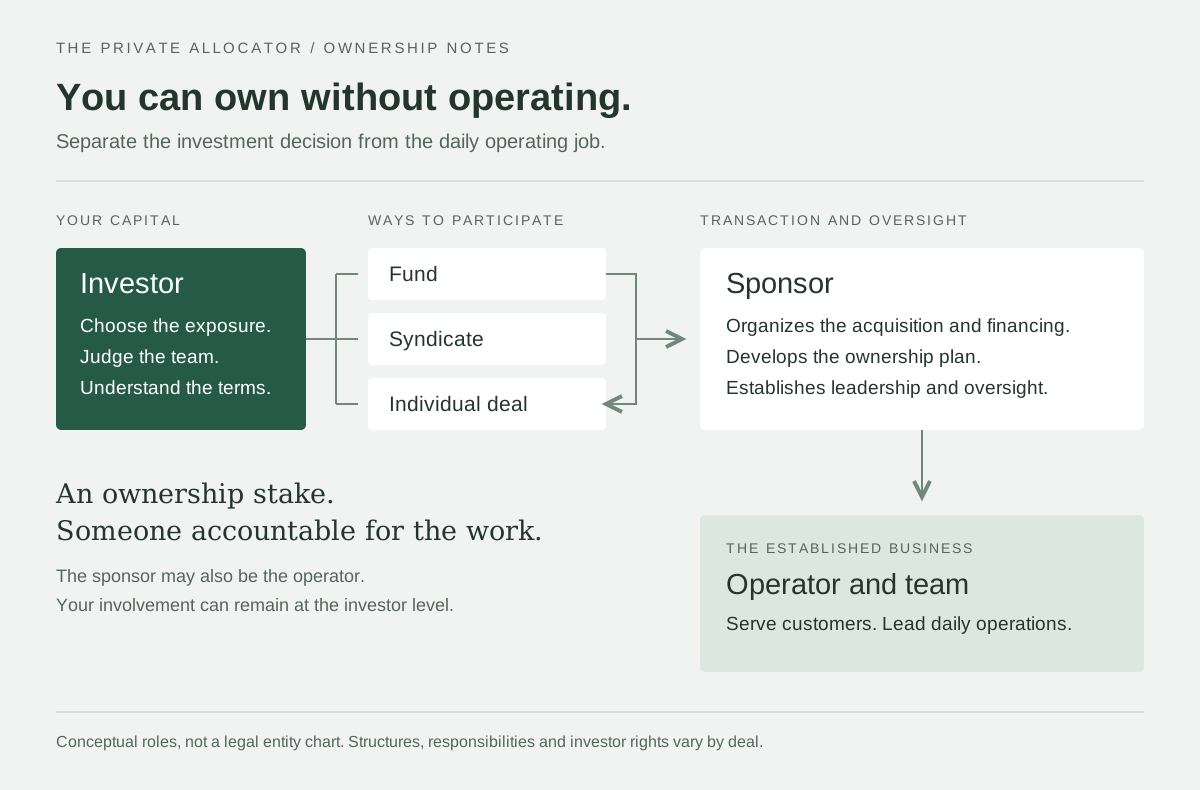
Conceptual structure. Roles and investor rights vary by deal; a sponsor may also be the operator.
Show me the work
When I look at a sponsor, the depth of their materials matters. I want to see how far they’ve worked through the business and the transaction.
A confidential information memorandum, or CIM, introduces the company and its financial story. It may come from the seller or broker. What interests me is the sponsor’s work beyond that presentation: what they checked, what they challenged, and what they still haven’t resolved.
Through my work with SMB Investor Network, I’ve become particularly interested in making those questions explicit. Who runs the company when the seller leaves? What earnings remain after paying for the management and systems the new owners need? What happens to cash if sales fall while debt payments continue? What do investors own, and who gets paid before they do?
I want an entrepreneur who can explain the negative outcomes without becoming vague or defensive. Someone who knows which customer relationships matter, where the operating plan is vulnerable, and what would cause them to walk away.
Experience matters to me, especially experience carrying real operating responsibility. A polished presentation or a recognizable credential doesn’t answer those questions. Neither does having other investors lined up. Their participation is a reason to understand their reasoning, not a substitute for your own. The same discipline belongs in an ongoing private portfolio review.
What I’m hunting for
The outcome that gets my attention is a credible path to turning an investment into roughly four times its original value over five to ten years, before any additional syndication fees and carried interest. Carry is the organizer’s share of investment profits, and the actual terms determine what reaches you.
That’s my ambition when looking at an opportunity. It isn’t a forecast or a return I assume every deal will produce.
Stanford’s search-fund research is part of what drew my attention to the space. Its historical findings deserve a careful read, including the structures and outcomes being measured. I wouldn’t take an aggregate study result and treat it as the likely result of whichever acquisition happens to be in front of me.[1]
I want the business to make sense without heroic growth assumptions. Continued earnings and debt repayment can contribute to the outcome, but only if cash remains after the real costs of running the company. Improvements under a capable operator can add to that foundation.
When I talk about protecting the downside, I mean doing the work to understand how the investment breaks and what room there is to respond. I still have to accept that I can lose money. Confidence should come from the analysis, with the uncomfortable parts left in.
Learn alongside people who do this seriously
My strongest view for someone starting out is to learn alongside experienced investors. Don’t skimp on diligence because the opportunity feels exciting or the sponsor seems likable.
This is real finance. You can learn it. Books, frameworks, and exposure to actual underwriting can help you develop judgment over time. Working with experienced people gives you a chance to see how they investigate a deal, challenge its assumptions, and decide to pass.
You can also choose how involved you want to become. Some investors want a manager to handle selection. Others enjoy evaluating individual deals. Some have expertise or relationships an operator would welcome. Contributing should be useful and invited; taking the CEO job isn’t a requirement for being an owner.
The first thing I’d ask an experienced investor to walk me through is a deal they rejected. Show me what looked promising, what they investigated, and what changed their mind. That’s the part of the hunt I’d want to learn before writing a check.
Source note
[1] Stanford Graduate School of Business, 2026 Search Fund Study: Selected Observations. Historical research context; no study return statistic is reproduced here. Personal views and preferences are the author’s own; the return ambition is not a study finding or forecast.